Energy Auditing
August 18, 2026
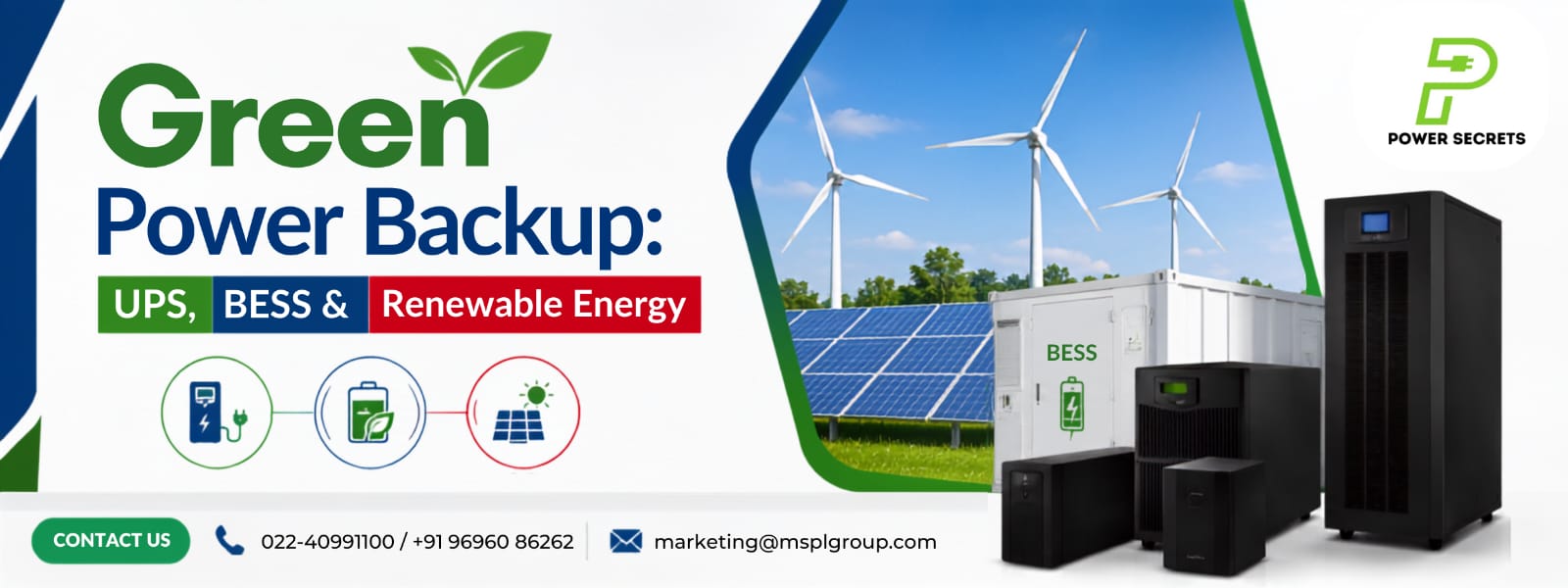
Green Power Backup: UPS, BESS & Renewable Energy Solutions
Explore reliable and sustainable power backup solutions using UPS, Battery Energy Storage Systems (BESS), and renewable energy technologies. Learn how these solutions provide uninterrupted power, improve energy efficiency, reduce costs, and support a greener future.
Introduction:
Why Green Power Backup Matters for Modern Businesses
Power reliability and sustainability are no longer separate business priorities. Data centres, hospitals, manufacturing plants, commercial buildings, telecom facilities and IT environments need uninterrupted electricity while also reducing energy waste, emissions and operating costs. Green power backup brings these objectives together by combining UPS systems, Battery Energy Storage Systems (BESS), solar power and other renewable energy technologies into an intelligent energy strategy.
The key is choosing the right technology for the right load. A UPS protects sensitive equipment from interruptions, voltage disturbances and power-quality problems. BESS stores electrical energy for peak management, backup and energy optimization. Renewable energy, particularly solar PV, can reduce dependence on grid electricity and recharge storage when conditions allow. When these systems are intelligently integrated, businesses can move beyond traditional backup power toward a more efficient and resilient energy ecosystem.
This guide explains how green power backup works, where UPS, BESS and renewable energy fit, how organizations can evaluate ROI, and what to consider before investing. For critical infrastructure, the final design should be based on a professional load study, power-quality assessment, operating profile, safety requirements and applicable electrical standards.
What Is Green Power Backup?
Green power backup is an energy-resilience approach that combines efficient backup technologies with renewable generation and energy storage to maintain critical loads while reducing fuel consumption, energy losses and environmental impact. It may include high-efficiency UPS systems, lithium-ion batteries, BESS, solar PV, energy management software and grid interaction.
Unlike a conventional backup model that relies mainly on a generator and lead-acid battery bank, a green power architecture can use stored electricity and renewable generation more strategically. The objective is not simply to provide emergency power; it is to improve reliability, efficiency, energy flexibility and lifecycle economics.
UPS Systems: The First Layer of Critical Power Protection
A UPS remains essential when equipment cannot tolerate even a short interruption. Online double-conversion UPS systems continuously condition power and can transfer critical loads to stored energy when the utility supply fails.
For servers, networking equipment, medical devices, industrial controls and other sensitive loads, UPS technology provides protection against outages, sags, surges, electrical noise and frequency disturbances, depending on the system design.
Modern high-efficiency UPS systems can also reduce operating losses compared with older designs. Modular UPS architectures may provide scalability and redundancy, allowing capacity to grow with the business.
Lead-generation CTA: Planning a UPS upgrade? Start with a power assessment covering load capacity, criticality, runtime, redundancy and future expansion.
BESS: The Energy Storage Engine Behind Green Backup
Battery Energy Storage Systems (BESS) store electricity and release it when required. While a UPS is primarily designed around power continuity and power quality for critical loads, a BESS can serve broader energy-management functions.
A BESS can support backup power, peak shaving, load shifting, renewable-energy integration and demand management, subject to the system architecture and utility rules. Lithium-ion battery technology is increasingly used where high energy density, rapid charging and a long operating life are valuable.
The right BESS design depends on required power in kW, stored energy in kWh, discharge duration, cycling profile, ambient conditions, battery chemistry, thermal management, fire protection and controls.
Renewable Energy Integration: Solar + Storage + UPS
Solar PV is one of the most practical renewable energy sources for commercial and industrial facilities. When paired with energy storage, solar can contribute to daytime energy demand while stored electricity can support loads when solar production falls.
A coordinated architecture may combine solar PV, power conversion, facility loads, BESS, UPS-protected critical loads and an energy management system. The actual configuration varies by site; a professional engineer should determine whether AC-coupled, DC-coupled or hybrid configurations best suit the application.
UPS vs BESS vs Generator: Which Backup Technology Is Right?
Each technology solves a different problem. UPS systems are optimized for immediate continuity and power quality. BESS provides flexible stored energy for backup and energy management. Generators can provide extended-duration backup when fuel is available.
For many critical facilities, the best answer is not UPS or BESS or renewable energy. It is an integrated system in which each technology performs the task it is best suited for.
Lithium-Ion UPS and Battery Energy Storage
Lithium-ion batteries are attractive for many UPS and energy-storage applications because they can offer high energy density, efficient charging and a potentially longer service life than traditional lead-acid technologies. Their smaller footprint can be particularly valuable where floor space is expensive, such as data centres and urban commercial facilities.
However, lithium-ion systems require appropriate battery management, thermal controls, monitoring, protection and installation practices. Procurement should evaluate the complete battery system rather than comparing chemistry on price alone.
Green UPS for Data Centres and IT Infrastructure
Data centres need both availability and energy efficiency. A green data-centre power strategy can combine high-efficiency UPS systems, scalable battery storage, renewable electricity procurement or onsite solar, intelligent monitoring and efficient cooling.
For a data centre, the design should consider critical IT load, redundancy architecture, rack density, runtime requirements, generator coordination, power-quality requirements and future capacity. The goal is to reduce unnecessary conversion losses without compromising availability.
Green Power Backup for Manufacturing and Industrial Facilities
Manufacturing sites often have mixed loads: PLCs, automation systems, servers, instrumentation, production machinery and essential auxiliary equipment. A site-wide BESS may help manage demand and energy costs, while a dedicated UPS can protect controls and other sensitive equipment.
Solar generation can offset daytime consumption, while energy storage can help align stored electricity with the facility's operating schedule. The financial case becomes stronger when the system addresses several value streams rather than serving only as emergency backup.
Green Power Solutions for Hospitals and Healthcare Facilities
Healthcare facilities require exceptional power reliability. Critical medical equipment, operating rooms, diagnostic systems, communications and life-safety infrastructure may have different backup requirements.
A practical strategy can combine UPS protection for sensitive critical loads, BESS for additional energy resilience and renewable generation for energy-cost and sustainability objectives. Electrical segregation, redundancy, runtime, transfer arrangements and regulatory requirements must be addressed during design.
Commercial Buildings, Offices and Smart Facilities
Commercial buildings can use green power backup to support elevators, IT rooms, security systems, building-management systems and other selected loads. Solar PV can reduce daytime grid consumption, while BESS can support peak-demand management and backup functions.
An energy management system can monitor consumption, solar generation, battery state of charge and grid conditions. This creates a data-driven approach to energy optimization rather than treating backup equipment as an idle emergency asset.
Telecom, Edge Data Centres and Distributed Infrastructure
Telecom sites and edge facilities often operate in locations where grid reliability, space and maintenance access are challenging. Compact UPS systems, lithium-ion batteries, renewable generation and remote monitoring can provide a resilient architecture with fewer maintenance visits.
For distributed assets, remote visibility is particularly valuable. Operators can track battery health, alarms, runtime, temperature and energy performance and plan maintenance before failures become critical.
How Green Power Backup Improves Energy Efficiency
Efficiency gains come from several sources rather than one technology alone. High-efficiency UPS operation can reduce conversion losses. Solar can reduce grid energy purchases. BESS can shift energy use away from expensive periods where tariff structures permit. Intelligent controls can prevent inefficient charging and discharging patterns.
The correct objective is total system efficiency, not simply the efficiency rating of one component. Designers should evaluate conversion losses, battery round-trip efficiency, standby consumption, cooling requirements, operating temperature and the actual load profile.
ROI of UPS, BESS and Renewable Energy Systems
The business case for green power backup should include both avoided costs and resilience value. Depending on the project, financial benefits can include lower electricity consumption, demand-charge reduction, reduced generator runtime, lower maintenance requirements, improved battery lifecycle economics and better use of onsite renewable energy.
Annual benefit = energy savings + demand savings + avoided operating costs + other measurable benefits.
Simple payback period = total project investment ÷ annual financial benefit.
For a more accurate investment decision, organizations should calculate NPV, IRR, lifecycle cost, battery replacement assumptions, degradation, financing cost, electricity-tariff escalation and residual value. Backup reliability should also be evaluated because the cost of downtime can be far higher than the electricity bill.
Lead-generation CTA: Request a site-specific UPS, BESS and renewable-energy ROI assessment before investing in new power infrastructure.
BESS ROI: What Should Businesses Measure?
Before purchasing a BESS, measure the site's load profile, peak demand, tariff structure, outage history, critical-load percentage, renewable generation profile and operating schedule.
A BESS sized only for emergency backup may remain underutilized. A system designed around multiple use cases—such as peak shaving, solar self-consumption and backup—may deliver greater asset utilization, although actual savings depend on tariffs, controls, cycling and local regulations.
Green Backup Comparison: Conventional vs Integrated Energy Architecture
The right choice depends on site conditions. Green power backup should be evaluated as an engineered system, not as a marketing label.
Safety, Reliability and Lifecycle Considerations
Energy storage must be designed with safety as a primary requirement. Important considerations include battery management systems, thermal monitoring, electrical protection, ventilation or thermal management, fire detection and suppression strategy, equipment clearances, emergency procedures and applicable local codes and standards.
Lifecycle planning is equally important. Businesses should assess battery degradation, warranty conditions, replacement strategy, software support, spare parts, service capability and end-of-life handling before signing a project contract.
How to Plan a Green Power Backup Project
Start with the load rather than the technology. Identify critical and non-critical loads, record demand patterns, establish required runtime, assess power-quality issues and determine the site's renewable-energy potential.
Next, model possible architectures: UPS-only, UPS plus generator, UPS plus BESS, solar plus BESS, or an integrated UPS-BESS-renewable system. Compare capital cost, operating cost, resilience, space requirements, maintenance and expected ROI.
Finally, select an implementation partner capable of handling design, installation, commissioning, monitoring and lifecycle support. A good project should include clear performance assumptions and measurable success criteria.
Lead-generation CTA: Talk to our power-solutions team for a site assessment, UPS sizing review, BESS feasibility study or renewable-energy integration discussion.
Why Choose an Integrated UPS, BESS & Renewable Energy Partner?
Green power projects cross multiple disciplines: critical power, batteries, renewable generation, electrical distribution, controls and energy management. A capable solution provider should be able to evaluate the complete power ecosystem rather than recommending isolated products.
For businesses in India, project planning should also consider local grid conditions, electricity tariffs, applicable approvals, installation environment, service availability and the operating profile of the facility.
Green Power Backup Trends for 2026 and Beyond
The market is moving toward intelligent, modular and software-connected energy systems. Lithium-ion storage, higher-efficiency UPS platforms, digital battery monitoring, renewable-energy integration, microgrids and AI-assisted energy analytics are becoming increasingly relevant to organizations seeking both resilience and sustainability.
The long-term direction is clear: backup power is evolving from an emergency-only asset into an active part of the facility's energy strategy. Businesses that measure energy, storage and critical-load performance together can make more informed investment decisions.
FAQ
What is green power backup?
Green power backup combines energy-efficient backup systems such as UPS and BESS with renewable energy sources such as solar to improve power reliability while reducing energy waste and, where applicable, emissions and fuel dependence.
Is BESS better than a UPS?
BESS and UPS serve different purposes. A UPS is designed for critical-load continuity and power-quality protection, while BESS can provide energy storage and broader energy-management functions. They can also be integrated.
Can solar power work with a UPS?
Yes, solar can be integrated into a site's broader power architecture. The correct configuration depends on the UPS, inverter, battery system, critical-load requirements and desired operating mode.
Is lithium-ion suitable for UPS applications?
Lithium-ion batteries can be suitable for many UPS applications because of their energy density, charging characteristics and potentially long service life. The complete system should include appropriate battery management, protection and thermal-safety provisions.
How does BESS reduce electricity costs?
Where tariff structures and controls support it, BESS can store electricity and discharge it during higher-cost or high-demand periods. The actual financial benefit depends on local tariffs, load patterns, battery size, efficiency and operating strategy.
Can green power backup replace a diesel generator?
Not necessarily. For some applications, UPS and BESS can reduce generator runtime or provide alternative backup for defined durations. Long-duration resilience requirements may still justify generators or other backup technologies.
How do I calculate the right BESS size?
Start with required power in kW, required energy in kWh, backup duration, load profile, cycling requirements, battery efficiency and allowable depth of discharge. A detailed site assessment should then validate the design.
Is green power backup suitable for data centres?
Yes. Data centres can combine high-efficiency UPS systems, lithium-ion batteries, BESS, renewable electricity and monitoring technologies to improve resilience and energy performance. The architecture must be aligned with the required redundancy and availability level.
Conclusion:
Build a Smarter, Cleaner and More Resilient Power Future
Green power backup is not simply about replacing one battery or adding solar panels. It is about designing an integrated energy system in which UPS, BESS, renewable energy, intelligent controls and monitoring work together to protect critical operations and improve energy performance.
For data centres, hospitals, factories, offices, telecom networks and commercial facilities, the best architecture will vary according to load, runtime, tariff, space, reliability requirements and sustainability objectives. A professional assessment can identify the combination that delivers the strongest balance of resilience, efficiency and lifecycle value.
Ready to evaluate your next green power project? Talk to our team for UPS solutions, BESS feasibility, lithium-ion battery systems, renewable-energy integration and end-to-end power backup planning.